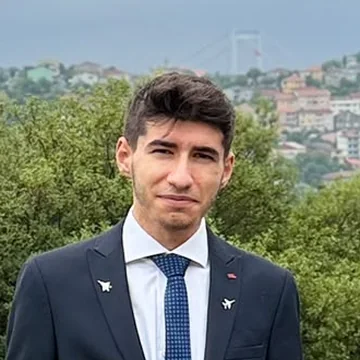
MSc student in Robotics, Systems and Control at ETH Zurich, and an Aeronautical Engineering
graduate of Istanbul Technical University, ranked first in the Faculty of Aeronautics and
Astronautics. Experienced in GNC, INS/GNSS sensor fusion with Kalman filtering, trajectory
optimization and machine learning for planning and control. Now working on robot learning.
Hover over the cards · drag the robot's jointsDrag the robot's jointsSwipe for more · drag the robot's joints
Guidance & Control
Proportional-navigation and pure-pursuit guidance, cascaded autopilots, MPC and LQR.
State Estimation
INS/GNSS sensor fusion with Kalman filters (EKF/UKF) and IMU error models.
Learning & Robotics
Reinforcement learning and learning-based planning, trained in simulation.
Multi-Agent Systems
Coordination, consensus and cooperative planning for teams of autonomous agents.
Education
ETH Zurich
Sep 2026 – Feb 2028
MSc Robotics, Systems and Control
MPC · Recursive Estimation · Robot Dynamics · Planning & Decision Making · Probabilistic AI · Game Theory & Control · Advanced Topics in Control · Vision Algorithms for Mobile Robots · Robot Learning
Model Predictive Control
Recursive Estimation
Robot Dynamics
Planning & Decision Making for Autonomous Robots
Probabilistic Artificial Intelligence
Game Theory & Control
Advanced Topics in Control
Vision Algorithms for Mobile Robots
Robot Learning
Istanbul Technical University
Sep 2022 – Jul 2026
BSc Aeronautical Engineering
GPA 3.95/4 · Ranked 1st in the Faculty of Aeronautics and Astronautics
Flight Mechanics
Automatic Control
Flight Stability & Control
Optimal Control
Guidance, Navigation & Control
RL & Optimization-Based Control
Aerodynamics
Aircraft Structures
Aircraft Design
Experience
Roketsan Missiles
Nov 2025 – Jul 2026
Candidate Engineer (engineering trainee program), Guidance & Autopilot — Air Defense Systems · Part-time
Completed a six-module, 14-week in-house Guidance & Autopilot program in MATLAB/Simulink, covering 3-D engagement kinematics, proportional-navigation/pure-pursuit guidance, and cascaded/state-feedback roll-autopilot design with stability, robustness, delay, noise and actuator-limit analyses.
Roketsan Missiles
Jul 2025 – Sep 2025
Sensor Fusion Algorithms Intern · Full-time
Reimplemented and validated Groves' MATLAB INS/GNSS integration using Kalman filtering, including inertial mechanization and IMU error models; assessed position, velocity and attitude estimates against simulated ground truth.
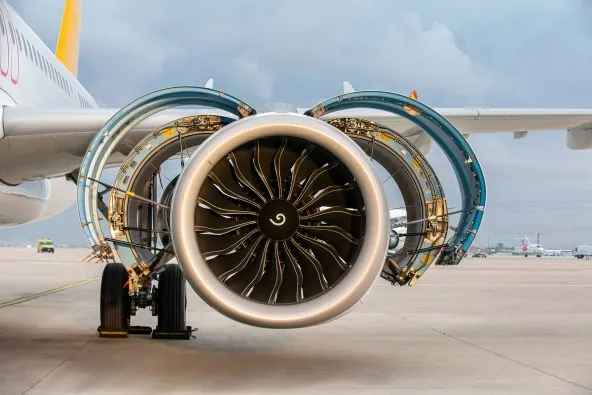
A320neo engine, nacelle opened for maintenance
Collins Aerospace
Jul 2025
Summer Intern, Thrust Reverser Systems · Full-time, 4 weeks
Assisted with thrust reverser maintenance and nacelle inspections for damage and wear.
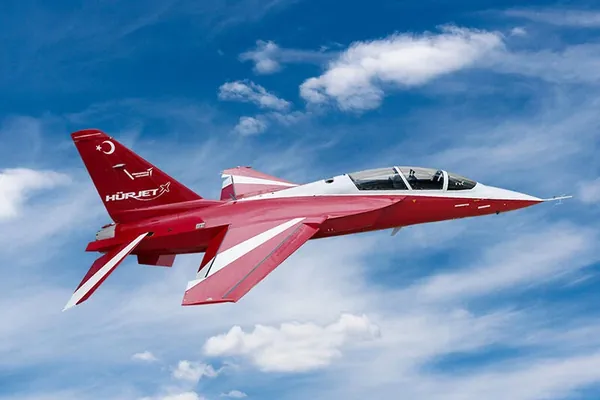
TAI Hürjet in flight
Turkish Aerospace
Dec 2024 – Jun 2025
Candidate Engineer (engineering trainee program), Aeroelasticity Department (Hurjet) · Part-time
Developed a real-time vibration fatigue estimation algorithm for jet aircraft wing structures using frequency-domain methods, continuing an ITU research project funded by Turkish Aerospace (since Sep 2024) that led to a peer-reviewed paper at AIAC 2025.
Research & Projects
Mixtures of Experts for Multi-Task Robot Learning
Ongoing project · Supervisor: Prof. Ioannis Mandralis (University of Cambridge)
Advisors: Sam Mady (NVIDIA), Prof. Demetri Psaltis (EPFL)
Learning to Accelerate Receding-Horizon MILP Path Planning
Planning over a 4 s horizon in 0.1 s steps, and replanning at every step, means solving a mixed-integer program again and again, and most of that effort goes into one question: which side of each obstacle to pass. I trained a small recurrent network, SideGRU, to answer it straight from the problem data. The planner fixes the answers the network is most sure about and lets SCIP solve the rest, so every plan is still valid for the original problem. On 100 unseen test problems this cut planning time by 79% (1.49 s → 0.31 s), and 87 of the plans were exactly as good as the full solver's.
Mean planning time per problem, full MILP vs. predict-and-fix. PyTorch, SCIP.
Direct collocation (CasADi/IPOPT) vs. a PPO policy; PPO within 1.4% of optimal fuel. Python.
How should a Boeing 737-800 fly a cruise leg through a known wind field to save fuel? I solved the same six-state aircraft model two ways: as an optimal-control problem with direct collocation (CasADi + IPOPT), which lands exactly on the destination, and as a reinforcement-learning policy (PPO, warm-started from expert trajectories) trained on randomly sampled routes. On the three benchmark flights the learned policy reached the destination every time and burned at most 1.4% more fuel than the optimum.
Fuel burned on the three benchmark flights. Python, CasADi, Stable-Baselines3.
Baseline evaluation and LoRA fine-tuning of Qwen3-1.7B, compared with RAG and GraphRAG.
In a three-person course project we turned Qwen3-1.7B, a small 1.7-billion-parameter language model, into a flight-mechanics assistant. We adapted it with LoRA fine-tuning, retrieval (RAG) and GraphRAG, and compared every version on a 300-question benchmark. Some versions answered clearly better than the base model and others did worse, depending on the method and the type of question. My part was the baseline evaluation and the LoRA fine-tuning.
Flight Mechanics Mission Simulation: New York JFK to Paris CDG
Jan 2025
Flight mechanics term project
Aircraft selection and full-mission simulation with BADA-style performance data in MATLAB.
Choose the best of three candidate aircraft for the 5,849 km New York–Paris route, then fly the whole mission in simulation. I compared range, take-off and landing distances and lift-to-drag ratio from BADA-style performance data, then stepped the aircraft state through every phase, from the take-off roll and step-climb cruise down to landing. The simulated flight took 417.7 minutes, against about 416 minutes for the real route.
@unpublished{kara2027accelerate,
  title  = {Learning to Accelerate Receding-Horizon {MILP} Path Planning},
  author = {Kara, Yunus Emre and Abu-Khalaf, Murad},
  note   = {Submitted to the 2027 European Control Conference},
  year   = {2026},
  url    = {https://github.com/yek44/predict-fix-rh-milp-path-planning/blob/main/paper/kara2027_learning_to_accelerate_rh_milp.pdf}
}
Vibration Fatigue Estimation for Jet Aircraft by Using Frequency Domain Methods
B. Yılmaz, T. Turan, Y. E. Kara, O. Eserler, S. Orhan, A. Tatar, O. U. Güngör
AIAC 2025 · Paper AIAC-2025-116 · Funded by Turkish Aerospace
@inproceedings{yilmaz2025vibration,
  title     = {Vibration Fatigue Estimation for Jet Aircraft by Using Frequency Domain Methods},
  author    = {Yılmaz, Büşra and Turan, Talha and Kara, Yunus Emre and Eserler, Oğuzhan and
               Orhan, Serkan and Tatar, Ali and Güngör, Olgun Utku},
  booktitle = {13th Ankara International Aerospace Conference (AIAC 2025)},
  address   = {Ankara, Turkey},
  note      = {Paper AIAC-2025-116},
  year      = {2025}
}